Lowest deposit

BC.Game
No deposit cap
Read reviewWe tested 9 operators across a 30-day window using a 5-point KYC severity rubric. BC.Game scored 2/5 - lowest overall friction. Roobet scored 5/5 - tightest. The full matrix is below; use-case routing answers "best for me, at the size I play, given my jurisdiction" after that.
Verdict at top - 4 winners by use-case
Severity is observable, not advertised. BC.Game wins overall and largest no-KYC withdrawal; Cloudbet wins no-KYC sportsbook; BC.Game wins provably-fair; Shuffle wins lowest-friction first-deposit testing. Side-by-side below.
KYC severity matrix
Severity is scored on a 5-point rubric per our methodology section 3. Lower is friendlier. The 9 operators are ranked ascending - BC.Game at 2/5 leads, Roobet at 5/5 trails. Deposit and withdrawal thresholds are the observed levels at which document submission triggered during our 30-day window in launch baseline 2026 section 4. Thresholds drift quarterly - last verified 2026-06.
| Operator | Severity (1-5) | Deposit no-KYC | Withdrawal no-KYC | Tier 1 / Tier 2 docs | |
|---|---|---|---|---|---|
|
BC.Game
|
2/5 | No cap observed | ~USD $2,000 cumulative | ID + selfie / address proof at higher tier | Play Review |
 Shuffle
|
2/5 | No cap observed | ~USD $1,800 cumulative | ID + selfie / address proof at higher tier | Play Review |
 Stake.com
|
3/5 | No cap observed | ~USD $1,500 cumulative | ID + selfie + address at threshold | Play Review |
 FortuneJack
|
3/5 | No cap observed | ~USD $1,200 cumulative | ID (provincial DL accepted in CA) + selfie | Play Review |
 Cloudbet
|
3/5 | No cap observed | ~USD $2,200 casino / ~$900 sportsbook | ID + selfie; sportsbook tier triggers earlier | Play Review |
 BitStarz
|
4/5 | No cap observed | Mandatory pre-first-withdrawal | ID + selfie required before any payout | Play Review |
 Vavada
|
4/5 | No cap observed | ~USD $500 cumulative | ID + selfie / address proof at higher tier | Play Review |
 1Win
1Win
|
4/5 | No cap observed | ~USD $400 cumulative (varies per GEO) | ID + address proof; AML-flag escalation common | Play Review |
 Roobet
|
5/5 | Lower-trigger flag in several GEO | ~USD $200 / ID near registration in many GEO | ID at signup in some GEO; address proof at low cumulative | Play Review |
All 9 operators in our launch baseline appear in the matrix above with severity scores plus deposit + withdrawal thresholds. Vavada is an affiliate-partner operator - disclosure adjacent per row 4/5 entry, see policy. Roobet excludes Australia and 36 other jurisdictions per current Terms; check operator availability before depositing. Methodology and rubric: how we test, section 3.
Use-case routing
Composite KYC severity answers "best overall low friction." These four use-cases answer "best for the thing I actually care about."
No deposit cap
Read review
~$2,000 cumulative
Read review
AFL + NRL + 50 sports
Read review
In-house Originals
Read reviewHonest risks
The editorial differentiator on this page is that we name the trade-offs. UK no-KYC SERPs are held by doorways that don't address these risks. We do - because if the page is honest about what you lose, the recommendation has more weight when we make it.
All 9 operators here are licensed offshore (Curacao GCB or Anjouan). No UKGC, AGCO, ACMA or equivalent dispute resolution. Frozen withdrawal or denied bonus claim runs through operator support first, then Curacao GCB process. No regulator-backed remedy at the player end.
"No-KYC" advertised on the marketing site; KYC requested at first cumulative withdrawal above threshold. Player deposits and plays under one expectation, then hits a different reality at cash-out. The 9 operators here have observable threshold patterns from our testing window; many other offshore operators do not publish thresholds at all.
Tier 3 documentation (bank statements covering deposit period, employer letter, business income proof) can hit even at no-KYC operators at sustained high volume. AML compliance officers escalate when deposit pattern flags. The "no KYC" framing breaks down at the volume where money actually accumulates.
UK and AU sanctions are operator-facing, not player-facing - player-side prosecution is virtually unprecedented. But offshore play sits outside any regulator-backed remedy. UKGC LCCP 17.1 doesn't apply. ACMA prohibited-services register applies to operators, not your balance. The friction reduction is real; so is the protection reduction.
Operator may freeze account during AML review if deposit pattern, withdrawal pattern or external chain-analytics flag is raised. Balance remains locked through review window - potentially weeks. Tier 2 or Tier 3 documents requested at that point. Worst-case the AML team can decline release entirely if source-of-funds doesn't pass internal threshold.
No-KYC operators leave on-chain traces. CRA, ATO and IRD all use commercial chain-analytics tools (Chainalysis CRA contract since 2018) plus exchange KYC at the fiat ramp. Self-custody crypto avoids the conversion trigger; it does not change tax-residence reporting obligations. The on-chain trail is not private.
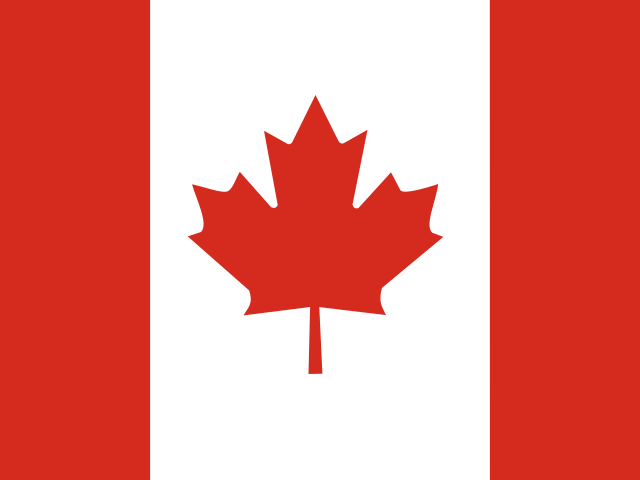
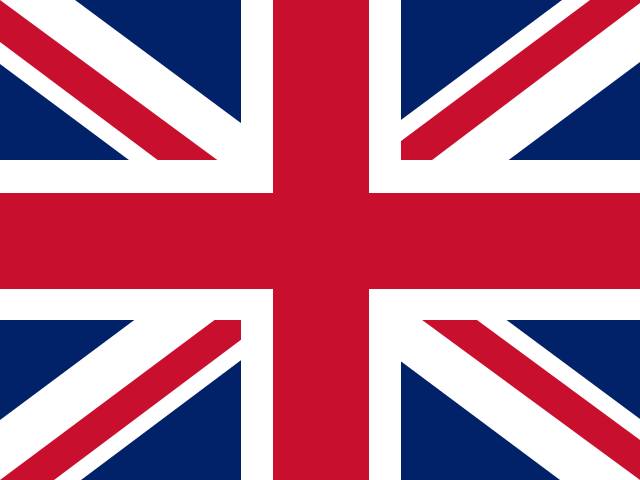
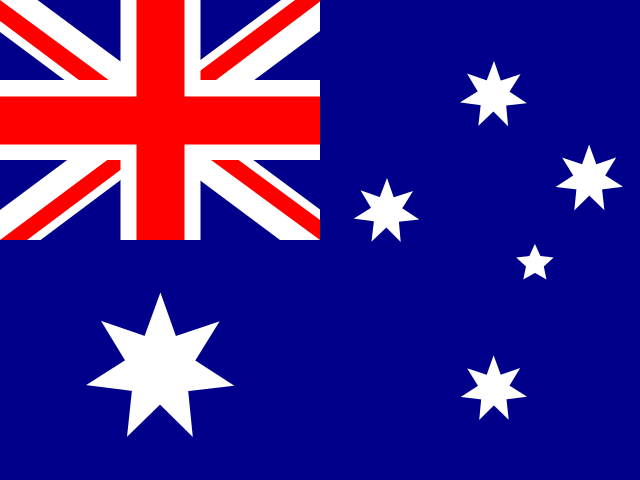
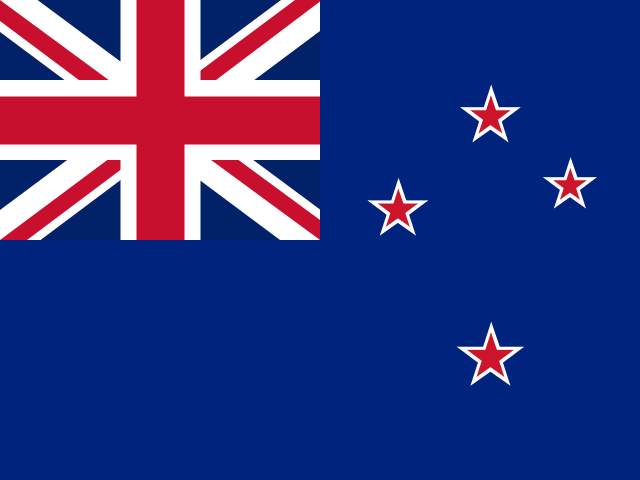
4-GEO availability
No-KYC is jurisdiction-sensitive. The same 9 operators have different exclusion patterns per jurisdiction. The matrix below is the at-a-glance read; the mini-sections after answer the regulator question per GEO.
| Operator | Canada | United Kingdom | Australia | New Zealand |
|---|---|---|---|---|
| BC.Game | Accepted | Excluded 2024 | Accepted | Grey-zone |
| Shuffle | Accepted | Excluded | Accepted | Grey-zone |
| Stake.com | ex-Ontario | Exited 2025 | Excluded T&C | Grey-zone |
| FortuneJack | Accepted | Excluded | Accepted | Grey-zone |
| Cloudbet | Accepted | Excluded | Accepted | Grey-zone |
| BitStarz | Accepted | Excluded | Accepted | Grey-zone |
| Vavada | Accepted | Offshore-only | Accepted | Grey-zone |
| 1Win | Accepted | Offshore-only | Accepted | Grey-zone |
| Roobet | Excluded | Excluded | Excluded | Grey-zone |
PAA: "Can the CRA track crypto wallets?"
CRA receives FINTRAC-flagged reports above CAD $10,000 and uses commercial chain-analytics (Chainalysis CRA contract since 2018). Gambling winnings tax-free for non-professional players per CRA Folio S3-F9-C1 lineage. Stake is accepted ex-Ontario (iGaming Ontario closed-licence regime). 8 of 9 operators are CA-accessible - Roobet excludes Canada in its 37-territory restricted list. See CA no-KYC ranking + CA-accessible operators.
ConnexOntario1-866-531-2600
PAA: "Are no-KYC casinos safe?"
UKGC LCCP 17.1 requires KYC at all UK-licensed casinos - no legal no-KYC route in the UKGC market. None of the 9 operators here holds a UKGC licence. BC.Game, Shuffle, Stake, FortuneJack, Cloudbet, BitStarz and Roobet exclude UK per current Terms; Stake exited 11 March 2025 (TGP Europe shutdown post-UKGC investigation); BC.Game excluded UK since 2024. Vavada and 1Win remain accessible offshore but operate without UKGC consumer protection, IBAS arbitration or GAMSTOP enforcement. See Non-GAMSTOP and what it means.
BeGambleAware0808-8020-133
PAA: "What casinos have no KYC?"
Interactive Gambling Act 2001 prohibits providing interactive gambling services to AU customers without an Australian licence; ACMA enforces against operators, not players. AUSTRAC AUD 10,000 cash-threshold reporting applies at the exchange step. ATO position: recreational gambling winnings are not assessable income. Stake T&C exclude Australia (covered in our AU hub with the Melbourne origin story). 7 of 9 operators are AU-accessible - Stake excludes per T&C, Roobet geo-blocks Australia. See AU no-KYC ranking.
Gambling Help Online1800-858-858
Gambling Act 2003 + DIA framework
Gambling Act 2003 regulates NZ-based gambling operators; offshore operators sit in grey-zone access for NZ residents. Department of Internal Affairs (DIA) enforces locally; no equivalent for offshore. IRD position on gambling winnings: tax-free for recreational players (similar to ATO + CRA pattern). All 9 operators in the matrix have grey-zone NZ access at the time of testing. See closest GEO sibling (AU) for routing context until NZ hub launches Phase 1.5.
PGF NZ0800-664-262
Final recommendation
Composite severity answers "best overall low friction." The 7 routes below answer "best for me, at the size I play, given my jurisdiction." Each is grounded in our 30-day testing observations.
Lowest deposit-side trigger. No document submission across our small-bankroll testing.
100+ chains + BCD token economy. Highest cumulative no-KYC withdrawal ceiling held in testing.
Deepest sportsbook in production roster. Sportsbook tier triggers earlier - plan for ~USD $900 cumulative ceiling.
In-house provably-fair Originals + low KYC. See how provably-fair works.
Both AU-accessible. BC.Game leads casino + low KYC; Cloudbet leads sportsbook + low KYC. See AU no-KYC ranking.
Both crypto-native; both low-KYC at small volumes. Stake works outside Ontario per current Terms. See CA no-KYC ranking.
No-KYC offshore route
None of the 9 operators holds a UKGC licence. 7 of 9 exclude UK per current Terms; Vavada and 1Win are accessible offshore without UKGC protection. UKGC market requires KYC per LCCP 17.1 - no legal no-KYC route inside the regulated market. The honest answer is the structural one. See Non-GAMSTOP context.
For players who prioritise regulator protection over KYC friction. The ACMA-licensed AU wagering market and the iGaming Ontario CA market are non-crypto-native alternatives with proper consumer protection.
Methodology + disclosure
5-point KYC severity rubric (1 = lowest friction, 5 = highest)
Full protocol: how we test, section 3. Raw measurements per operator: launch baseline 2026, section 4 (30-day testing window across 9 operators). Re-scoring cadence: quarterly. Thresholds drift - confirm before depositing at the size you plan to play.
Multi-operator affiliate disclosure
FAQ
BC.Game scores 2/5 on our severity rubric - lowest of the 9 operators in our launch baseline. Shuffle ties at 2/5. Both trigger KYC only on cumulative-withdrawal threshold around USD $1,800-$2,000.
Stake, FortuneJack and Cloudbet sit at 3/5 with thresholds in the USD $900-$2,200 range depending on product. BitStarz, Vavada and 1Win score 4/5 - mandatory pre-withdrawal documents or low threshold. Roobet scores 5/5, the tightest friction in the roster, with ID requested near account creation in many jurisdictions.
The same 5-point protocol applies across all 9 operators. Full severity matrix with deposit + withdrawal thresholds per operator sits above.
None of the 9 operators we tested is truly no-KYC at all volumes - the friction is threshold-triggered.
BC.Game and Shuffle are the lowest-friction in our 9-operator launch baseline (severity 2/5), with KYC appearing only at cumulative withdrawals around USD $2,000. Stake, FortuneJack and Cloudbet are the mid-band (3/5), triggering between USD $900 and $2,200. BitStarz, Vavada and 1Win are higher-friction (4/5). Roobet is the tightest (5/5).
Severity is observable in our 30-day testing window, not advertised on the operator marketing site. The full matrix with deposit + withdrawal thresholds per operator sits above.
Safe needs a qualifier. Lower-KYC offshore operators carry six observable risk categories we document in the Risks section above: no consumer-protection floor from a major regulator, bait-and-switch risk on withdrawal, source-of-funds escalation at high volume, jurisdiction enforcement gap, AML compliance lag with retroactive account freezes, and tax-authority visibility through on-chain analytics and exchange KYC.
All 9 operators in this comparison are offshore-licensed (Curacao GCB or Anjouan). None carries an equivalent of UKGC, AGCO or ACMA consumer protection. They are not a substitute for regulator-backed consumer protection - the severity score above ranks friction only, not full trust.
The honest framing: low-friction KYC at the size you play with these specific tradeoffs - not totally anonymous.
The Canada Revenue Agency cannot surveil individual wallet addresses directly. It can trace crypto-to-CAD conversion through two channels:
(1) FINTRAC-registered Canadian crypto exchanges (Wealthsimple Crypto, Bitbuy, Newton, NDAX, Kraken CA, Shakepay) report transactions above CAD $10,000 and submit Suspicious Transaction Reports under the Proceeds of Crime Money Laundering and Terrorist Financing Act.
(2) Commercial chain-analysis tools - Chainalysis has held public CRA procurement contracts since 2018. Withdrawing crypto from an offshore operator to a Canadian KYC exchange is a traceable event.
Keeping winnings in self-custody crypto avoids the conversion trigger but does not change tax status. See KYC at crypto casinos.
BC.Game observed the highest no-KYC cumulative withdrawal ceiling in our testing window - around USD $2,000 cumulative before document trigger, with Tier 1 (ID + selfie) accepted at the threshold. Shuffle is similar at a slightly lower ceiling. Stake and FortuneJack trigger earlier, typically USD $1,000-$1,500 cumulative.
Cloudbet's casino tier matches BC.Game but the sportsbook tier triggers earlier per Cloudbet's AML profile.
Important: single-event withdrawal is the headline number; cumulative is the real ceiling. Most players hit the cumulative threshold first because withdrawals accumulate across sessions, not within one. Live data: withdrawal benchmarks.
Cloudbet wins the no-KYC sportsbook category because Cloudbet leads our overall sportsbook scoring (AFL, NRL, Super Rugby, A-League, 50+ sports, deep in-play, original BTC sportsbook since 2013) and its KYC severity sits in the same band as Stake and FortuneJack for casino activity.
The sportsbook tier triggers KYC earlier than the casino tier at Cloudbet because of stricter AML profile on sports betting margins, but for sportsbook + low-KYC combination it is the strongest in the production roster.
Stake is a second option for sportsbook + crypto-native infrastructure but excludes Australian and UK players per current Terms.
Canada regulates gambling provincially. iGaming Ontario has run a licensed framework since April 2022 with about 50 registered operators - none of which are crypto-native offshore brands. Outside Ontario, no equivalent provincial crypto-casino licensing exists.
Criminal Code sections 201-202 prohibit operating an unlicensed gambling house in Canada, but federal enforcement targets operators and physical houses, not players. Player-side prosecution for using offshore operators from Canada is virtually unprecedented.
The CRA tax position: gambling winnings are tax-free for non-professional players per CRA Folio S3-F9-C1 lineage; crypto-to-CAD conversion may trigger capital gains separate from the gambling event. See CA-accessible operators.
UKGC-licensed UK operators are required to apply KYC per UKGC LCCP 17.1 - there is no legal route to a no-KYC casino product inside the UKGC licensed market.
Offshore operators do offer lower-KYC access to UK residents, but operate without UKGC consumer protection, IBAS arbitration, or GAMSTOP self-exclusion enforcement. Stake exited the UK on 11 March 2025 via the TGP Europe shutdown following the UKGC investigation. BC.Game has excluded UK players since 2024.
UK players accessing offshore no-KYC operators do so without regulatory backstop on disputes or balance recovery - the friction reduction comes with a corresponding consumer-protection reduction. See non-GAMSTOP context.
KYC at offshore crypto-casinos comes in three tiers.
Tier 1 is the lightest: government-issued photo ID (passport or driver licence) plus a selfie. Triggered at the first cumulative-withdrawal threshold, typically USD $1,000-$2,000 depending on operator.
Tier 2 adds proof of address: utility bill, bank statement, or council tax letter dated within 90 days. Triggered at higher cumulative volumes or on AML flag (deposit pattern, source-of-funds inconsistency).
Tier 3 is the heavy one: source-of-funds documentation - bank statements covering deposit period, employer letter, business income proof. Triggered on AML escalation at high volume or where deposit source flags. Tier 3 can hit even on so-called no-KYC operators at sustained high volume.
Six observable risk categories from our 30-day testing window:
(1) No consumer-protection floor - no UKGC, AGCO, ACMA or equivalent regulator dispute resolution, only operator support plus Curacao GCB process.
(2) Bait-and-switch risk - no-KYC advertised, KYC required at first significant withdrawal.
(3) Source-of-funds escalation - Tier 3 documentation can hit at high volume even on no-KYC operators.
(4) Jurisdiction enforcement gap - UK and AU sanctions are operator-facing not player-facing, but offshore play sits outside any regulator-backed remedy.
(5) AML compliance lag - operator may freeze account during retroactive AML review.
(6) Tax-authority visibility - even no-KYC operators leave on-chain traces; CRA, ATO and IRD use exchange KYC plus chain analytics.
All 9 operators in this comparison carry these tradeoffs to different degrees. The severity score above ranks the friction dimension; consumer-protection ranking is a separate question and sits outside this matrix.
Standards & Compliance
How we work - standards
KYC severity scoring re-run quarterly. Affiliate commission cannot influence severity scores or use-case routing. Vavada appears in the 9-operator matrix above at severity 4/5 - extended-relationship disclosed inline and on the Vavada review. Reader-reported errors corrected within 7 days with a dated note.